Prison Break
Starring the sliding pawns, the Ninja Guards, the Knight, the Bird, the King and introducing the captivating Ice Queen!The game is played utilizing 46 squares of a chessboard, and new unique pieces, all of which can be represented by the standard pieces.
The game situation is a prison with two opposing sides, each of which tries to either checkmate the opposing king, or to enable its king to escape by reaching the squares a4 or a5 safely. A king cannot flee the prison if the escape squares are controlled by the opposing piece (i.e. the king can be captured), so even though the two squares a4 and a5 are not occupied by any piece, they play an important part in the game.
Board Setup
The standard chess pieces can be used to represent the new pieces.Queen=Ice Queen
Bishop=Ninja Guard
Rook=Flying Bomber
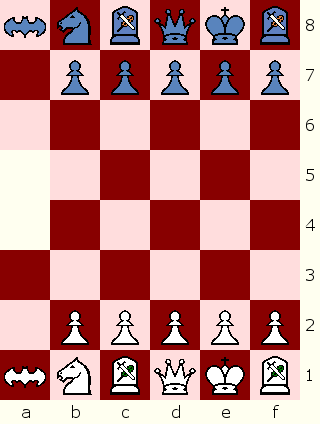 |
Start Position for white. (black mirrors white)
Flying Bomber on a1 Knight on b1 Ninja Guards on c1, f1 Ice Queen on d1 King on e1 pawns from a2-e2 |
Rules
The rules are as in orthodox chess except as noted below:- There is no castling.
- In addition to checkmate, a side can also win if its king can flee to the squares a4 or a5.
- An Ice Queen can checkmate by merely checking (see Ice Queen moves).
- The unused squares (a4,a5) do not hinder the movement of any pieces. A piece can prevent a king from escaping to a4 or a5 by capturing even if it must land on a4 or a5 to capture the king. E.g. Black flying bomber on a7 prevents white from moving king to a4 since a7-a3 is threatened or to go to a5 since a7-a4 is threatened.
- Pawns promote on the last rank to Ice Queen, ninja-guard, flying bomber or knight.
- All rules governing draws including stalemate are exactly as in orthodox chess
The Ice Queen
Things get even more complicated because of the presence of the beautiful but deadly ice queen.She moves one step in any directionjust like the king, capturing if possible, but any enemy piece including the king that is attacked by her is frozen and cannot move!
-
Ice Queen Rules
- Any piece that moves into her range will be frozen!
- Pieces can move through her range though. E.g. a flying bomber can pass adjacent to her and as long as it does not land within range it will be unfrozen
- To attack an ice queen, the attacking piece must be at least two squares away and thus safely out of her range.
- Consquently, an ice queen cannot attack another ice queen because it becomes frozen first.
- Frozen pieces CANNOT move or attack another piece neither can they deliver check.
- A piece can only be unfrozen if the hostile ice queen is captured by another piece or if the ice queen moves away.
- As soon as a piece is unfrozen it can attack another piece or deliver check. Thus in some cases, the ice queen may be pinned by the frozen piece!
- An Ice Queen can capture any piece in its vicinity just like a king does. The only difference is that the captured piece is already frozen.
- A simple check by an Ice Queen can lead to checkmate if the Ice Queen cannot be captured.
NOTE that a king can NEVER capture an ice queen since it will be already frozen if within her vicinity.
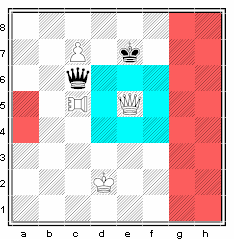
|
Frozen Delimma!
In this position black must move the king away by one step because white is threatening checkmate with: e5-e6 or e5-f6. White cannot play e5-d6 because its Ice Queen will become frozen. Note that black's best move is e7-d8. This move is NOT illegal since the pawn is frozen and cannot attack the king. Black on the other hand has frozen both the flying bomber at c5 and the pawn at c7. In addition to the checkmate threat, white has imposed a strange pinning predicament on black. If the ice queen takes the flying bomber than white can promote the pawn. Similarly, if the ice queen captures the pawn then white flying bomber can capture the ice queen at c7. |
The Ice Queen was inspired by Sub-Zero of Mortal Kombat. In the famous arcade game, this shady character would freeze his enemy to ice, and then shatter his enemy to pieces with a strike.
On a more humorous note, the Ice Queen bears some resemblance to the infamous Tonya Harding, an ice skater who hired a henchman to take out the knees of her rival Nancy Kerrigan.The Ninja Guard’s Moves
The Ninja Guard is a color bound piece that can move one or two steps diagonally. It can leap over a diagonally adjacent friendly piece to land exactly 2 squares away (a two-space diagonal leap). It can capture on any square it lands, and additionally it can can capture an enemy piece that is diagonally adjacent by jumping over it. It can capture two pieces (the first immediately adjacent to it, and the next right after) in its path on a diagonal by jumping over the first one and capturing the second piece on the square it lands.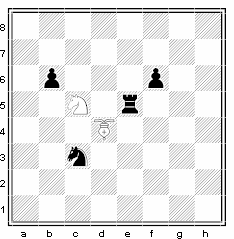 |
The Ninja Guard on d4 can capture all the pieces in the diagram.
It can capture the pawn on b6 by jumping over the knight at c5. It can capture the knight on c3 by moving to c3 or by jumping over the knight and landing on b2. It can capture the rook on e5 by moving to e5 or it can capture both the rook and the pawn by jumping over to f6. |
The Bird’s (Flying Bomber’s) Moves
*The flying bomber's shape resembles a bat, hence the iconographic symbols used. However, the flying bomber is also referred to as the "Bird" - a common nickname given to fighter planes. The choice of name is left to the player.
The flying bomber's odd combination of long-range and short-range moves makes it a deadly weapon against an unsuspecting opponent.
Standard Move:- The flying bomber eliminates an enemy piece by flying over it, and landing on THE empty square immediately after it on the same orthogonal line. It cannot fly over or capture a second piece or land on any square beyond the first empty square.
- The flying bomber can fly along any amount of empty squares (1-9) orthogonally, but not over any friendly pieces. This is identical to the movement of a rook.
Special Move: the Helicopter Landing
This is a special maneuver that enables the bird to fly over the adjacent square, (jumping over, if occupied by friendly piece or eliminating if occupied by enemy piece) and land like a helicopter on a square exactly 2 squares away, capturing if possible on this square. It can capture two pieces in this manner.Essentially, it combines its standard move with that of a two space orthogonal jumper.
This peculiar short-range prowess in more detail:
- The Flying Bomber can fly over one friendly piece adjacent to it (left, right, up or down) and land on an empty square immediately after it. When it flies over an adjacent friendly piece, its range is limited to two squares.
- If an enemy piece is exactly 2 squares away orthogonally and no other piece is in-between, then the flying bomber can capture the usual way by flying over it and landing on the empty square after it. It can also capture by landing on the same square as the enemy.
- If two enemy pieces lie on the same line, the first one adjacent to the flying bomber, and the next two squares away, then it can eliminate both pieces by landing on the square of the second enemy piece. (see diagram 1) It cannot fly over the second enemy piece.
- Similarly, if there was a friendly piece in immediate vicinity of the flying bomber, and an enemy piece right after it, then the bird can fly over the friendly piece and destroy the piece right after by landing on the same square. Here too it cannot fly over beyond the enemy piece as it cannot fly over two pieces.
- The Flying Bomber needs at least one square to fly over for a bombing. e.g. it can destroy any enemy piece in its vicinity (1 square to left, right, up or down) by flying over it and landing on the empty square after it, but if a friendly piece occupies a square immediately after the enemy piece, no capture can be made. (see diag 2)
- It must capture the enemy piece it jumps over. (capturing is not optional).
It is easier to remember the flying bomber moves as a combination of the standard move with the move of the Dabbabah - a leaping move two squares in any orthogonal direction.
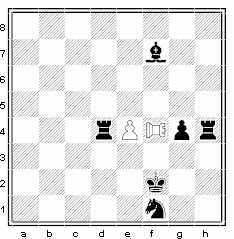 diag 1 (sideways rook rep. flying bomber) |
Diag. 1: The flying bomber on f4 is posing multiple threats to black's pieces.
It is threatening to destroy the black bishop on f7 by moving f4-f8. Using its special 2 square helicopter capability, it is threatening the black rook on d4 by moving f4-d4 (flying over its own piece and bombing/landing on d4). It cannot land on any squares beyond d4. This same short-range prowess gives it the ability to threaten f4-h4, flying over and bombing pawn on g4 and landing/bombing rook on h4. Note that the bomber cannot move to g4 by capturing the pawn, it must eliminate both the pawn and the rook. If there was no rook on h4 then the bomber can just capture the pawn by moving f4-h4. Note that the bird IS giving check to the king because it is exactly 2 squares away, and the bird can land on f2. However the bird is not threatening the knight on f1 since it is more than 2 squares away and there is no empty square beyond it. If the king moves, the knight will not be under attack either. |
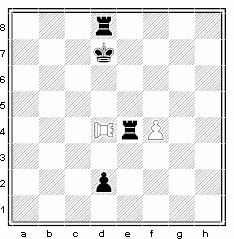 diag 2 (sideways rook rep. flying bomber) |
Diag 2: Here the Flying Bomber is hampered by Black’s Pieces.
It is not checking the king at d7 because there is no empty square behind it (and it is not exactly 2 squares away from it). The rook on d8 is pinned, because moving it would enable the king to be captured. However, the king can simply move away and the rook on d8 is not threatened because there is no empty square beyond it. The rook on e4 is adjacent to the flying bomber and threatening it. But the Flying Bomber cannot do anything because the white pawn occupies f4 and the bomber needs an empty square after its target. If f4 was an empty square, the bomber could capture the rook, and if there was another enemy piece on f4 instead of the white pawn, then the bomber could have captured both pieces. The Flying Bomber does attack the pawn on d2. It can fly d4-d1 OR move d4-d2 to eliminate the pawn. Because it is 2 squares away, the bomber can land on the same square as its target. |
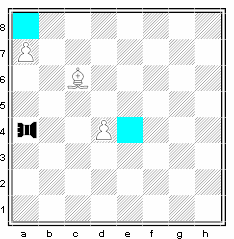 diag 3 (sideways rook rep. flying bomber) |
Diag 3:
Here the black Flying Bomber is threatening white’s pawns at d4 and a7.
However, the white bishop is defending both pawns (colored squares). To make matters worse the bishop is also attacking the bird! |
The Extra-mobile sliding pawn
The pawn moves and captures exactly as in orthodox chess except for the following. Normally, when a pawn faces an opposing pawn or an enemy piece, the pawn is blocked. However, the sliding pawn can, under these circumstances only if it is blocked, slide pass the enemy piece or pawn with the same 1-step diagonal movement that it would make when capturing.
Play!
Play Prison Break!|
If you would like to email the chess variant inventor directly: inventor@chess.computerwebservices.net
|
|
Posted by: BombsAway on 2022-12-21 09:26:11 Like Chess: YES A very interesting variant - the ice queen and flying bomber are very unique new pieces! Posted by: Observer on 2022-04-13 18:46:58 Like Chess: YES
Amazing little variant! |


